
In our previous post, How to Write Threat Detection Rules That Actually Work, we explored why detection rules based on simple string matching are incredibly fragile in real-world adversarial environments. Attackers can easily bypass static rules by exploiting the flexibility of OS parameter parsing (e.g., parameter reordering, alias substitution, and encoding transformations).
Writing highly robust rules requires detection engineers to have a deep offensive mindset and exhaustively anticipate attacker variations. However, in the high-pressure day-to-day of security operations, relying solely on manual review to find the "blind spots" of every single rule is not only time-consuming but highly prone to omissions.
Over my years as a detection engineer, one thought has constantly kept me on edge: Just how many unanticipated bypass scenarios are hiding in the detection rules we consider "perfect"?
To completely eliminate this defensive anxiety and help detection engineers spot potential vulnerabilities more efficiently, we are open-sourcing a new AI-assisted analysis Skill: Detection Rule Bypass Analyzer.
Why Do We Need Automated Analysis?
Let's look at a real-world scenario. Suppose you need to detect an attacker using the split -b command to chunk sensitive files for data exfiltration. You might write a rule like this in your SIEM (e.g., Splunk):
index=detectiontable Image="/usr/bin/split" ParentImage="/usr/bin/bash" | Regex CommandLine="split\s-b"This rule seems logically sound: it restricts the process path and parent process, and uses a regular expression to strictly match the command line. But in the wild, can this rule be easily bypassed? The answer is yes—and there might be dozens of ways to do it.
Manually hunting down these bypass techniques requires spending countless hours digging through Linux Man pages and testing system behaviors. This is exactly where the Detection Rule Bypass Analyzer comes in.
Enter the Detection Rule Bypass Analyzer
The Detection Rule Bypass Analyzer is an open-source "Skill" designed specifically for detection engineers and SOC analysts. It integrates seamlessly into AI agents like Claude Code, Cursor, and Codex.
It has one core objective: to automatically assess the risk of rule evasion based on real-world OS command parsing behaviors, and generate concrete bypass test cases.
When you feed the Splunk rule above into the Analyzer, it ruthlessly deconstructs it from several angles:
1. Parameter & Syntax Bypasses
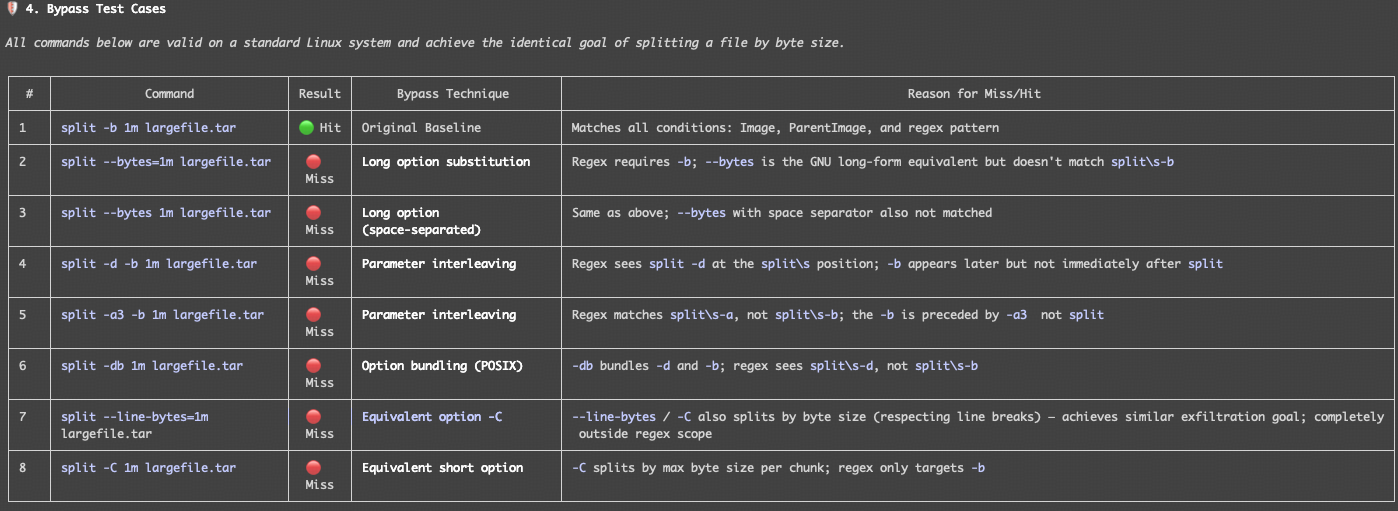
The regex split\s-b in the rule requires -b to immediately follow split with exactly one space. The Analyzer will immediately point out the following blind spots:
- Long option substitution:
split --bytes=1m largefile.tar(Completely omits-b, perfectly evading the regex). - Parameter interleaving:
split -d -b 1m largefile.tar(Inserts the-dparameter, breaking the regex's adjacency requirement). - POSIX option merging:
split -db 1m largefile.tar(Merges-dand-b, rendering the regex completely useless). - Equivalent parameter substitution:
split -C 1m largefile.tar(Uses-Cto split by line bytes, achieving the same exfiltration goal but falling outside the detection logic).
2. Alternative Tool Bypasses
The Analyzer also steps outside the confines of a single command, suggesting alternative tools an attacker might use to achieve the exact same goal. For instance, to chunk files for exfiltration, an attacker could easily ditch split and use dd or csplit instead.
This Skill doesn't just blindly guess bypass commands using an LLM. Under the hood, it actively consults the command's help output or official documentation. It anchors itself to the "detection objective" of your rule to deduce and verify whether these bypass behaviors are actually viable.
Closing the Loop: From Discovery to Hardening
Pointing out the problem is only the first step; fixing it is what matters. Based on its analysis, the Analyzer automatically provides remediation advice. For the fragile rule above, it would suggest:
- Remove brittle context constraints: Drop
ParentImage="/usr/bin/bash"to prevent attackers from bypassing the rule viash,zsh, orcron. - Adopt elastic regex: Cover long/short options and merged parameters.
- Expand the detection surface: Include equivalent tools in your monitoring scope.
The optimized, highly robust rule might look something like this:
index=detectiontable (Image="*/split" OR Image="*/dd" OR Image="*/csplit")
| Regex CommandLine="(?i)(split\s+.*-(b|C|-bytes)|dd\s+.*bs=|csplit\s+)"
(Note: The exact rule should be fine-tuned based on the performance and noise levels of your specific environment.)
Conclusion
The gap between a "written rule" and an "effective rule" is much wider than we'd like to admit. And hiding within that gap are fatal false negatives.
Detection engineering is never a "set it and forget it" job; it's an ongoing game of cat and mouse. We hope the Detection Rule Bypass Analyzer becomes your go-to assistant for writing and reviewing rules, using automated "shift-left detection" to reduce false negatives and boost the resilience of your defense posture.
🚀 The project is now open-source on GitHub:
👉 Click here to access the GitHub repository
If you want to validate these rules in a highly simulated environment or learn more practical techniques for threat detection and evasion, check out the SOCLabs Platform. We provide rich cyber range challenges and realistic background noise data to help you level up as a detection engineer.